


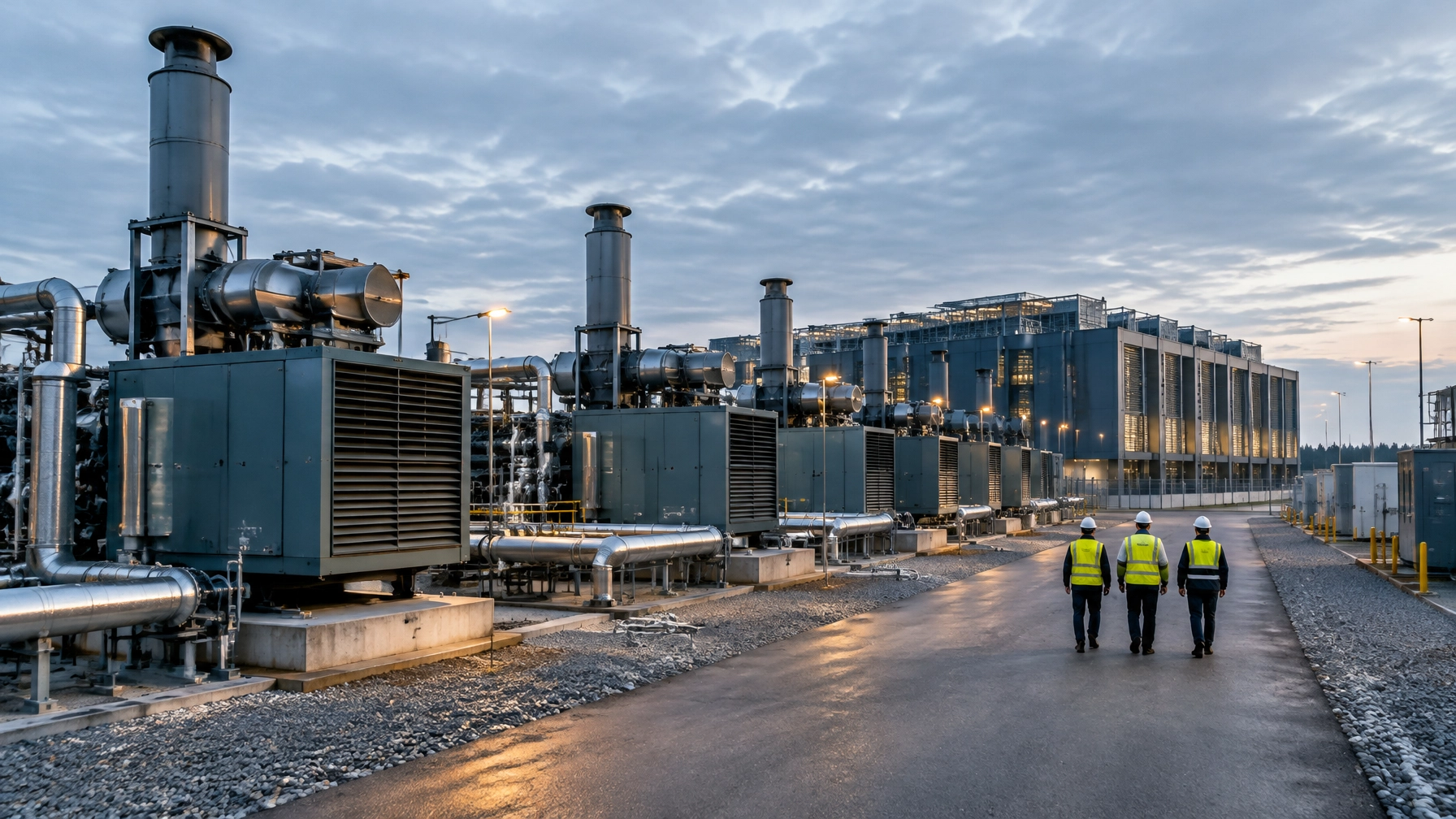
The reported deal is striking, but the real story is bigger than a line item for generators. It’s about a company trying to secure the power behind its AI ambitions, even if that means taking on work and risk that might normally sit with suppliers or utility providers.
According to reporting published today, Anthropic finalized an agreement in late September valued at about $3.4 billion with Texas-based OnePWR Solutions. The arrangement reportedly covers 1.7 gigawatts of heavy-duty gas-fired generators, along with engineering and construction services to install them at data-center sites.
One important distinction: Anthropic did not buy OnePWR. Instead, it reportedly took over existing generator orders OnePWR had placed with Caterpillar. Nor does the deal mean Anthropic purchased $3.4 billion of natural gas. It concerns generating equipment and installation capability, not a disclosed fuel-supply contract.
That distinction matters. So does the bigger business lesson: when a critical resource is hard to secure through the usual channels, a company may decide to bring more of the process under its own control.
Power has become part of the AI race
AI data centers need enormous amounts of electricity, and building new facilities is only one piece of the challenge. A company can have land, financing and a construction plan, yet still face a long wait for the grid connection needed to operate at full capacity.
For an AI business, a delay in power can mean delayed computing capacity. That can affect product development, customer demand and revenue plans. In this context, reliable electricity is not simply an operating expense. It is a resource that can shape how quickly a company grows.
Anthropic’s reported move suggests one way of addressing that bottleneck: secure generation equipment directly and plan for power at the data-center site, rather than relying entirely on the timing of a conventional grid connection. It’s a significant choice, not a universal shortcut. Building and operating power systems brings its own challenges.

A reported equipment deal, not a simple pivot
It would be easy to summarize the news as “Anthropic is leaving the cloud behind.” That goes further than the facts support.
Anthropic’s recent S-1 update describes a broad infrastructure strategy that includes substantial compute and infrastructure commitments. It reports roughly $895 billion in aggregated purchase commitments and lease agreements. That figure covers different types of obligations and arrangements. It should not be treated as a single bill, a single data-center budget or a straightforward total of cloud spending.
The generator arrangement, as reported, is one piece of that larger picture. It points to a company seeking more control over a critical input while continuing to rely on other infrastructure relationships. In other words, “Anthropic Direct” is best understood as a shift toward taking responsibility for some parts of the infrastructure stack, not proof that every intermediary is being cut out.
That approach can create more control over timing and deployment. It can also move more risk onto the company’s own balance sheet. Gas-fired generation can bring exposure to fuel-price swings, fuel availability, operating complexity and the practical demands of running power equipment. The S-1 itself flags risks connected to natural-gas-powered data-center plans, including possible fuel-price volatility and supply disruptions.
The business lesson: own the bottleneck, not everything
For a small business, the scale of a multibillion-dollar infrastructure deal can feel worlds away from daily operations. But the underlying question is familiar: What is the one dependency that could keep your business from delivering?
It might be a single supplier, a software platform, a distribution partner, a key piece of equipment or a specialized contractor. If that resource becomes unavailable, what happens to your customers and your plans?
Owning more of a dependency can reduce your exposure to someone else’s schedule. But ownership can also mean more cost, complexity and responsibility. The goal isn’t to bring every function in-house. It’s to be deliberate about what you need to control, and what you can safely rent or outsource.

A practical checklist for deciding what to own or rent
Before committing to an in-house solution, walk through these questions:
-
How much does this dependency affect delivery?
If a delay would stop sales, service or production, it deserves a closer look. If customers would barely notice, outsourcing may remain the sensible choice. -
How often has the dependency failed or slowed you down?
Separate a one-time inconvenience from a repeated pattern. Keep track of missed deadlines, stockouts, system outages and the cost of workarounds. -
What would ownership actually require?
Add up the purchase or setup cost, staffing, maintenance, training, insurance and ongoing management. A solution that looks cheaper at first may become expensive once the full workload is counted. -
Can you secure priority without buying the whole capability?
Consider backup suppliers, reserved capacity, service-level agreements, longer-term contracts or a second platform. Sometimes a stronger agreement solves the bottleneck without requiring full ownership. -
What new risks would you take on?
Bringing a function in-house doesn’t erase risk; it changes who manages it. Think about price volatility, downtime, compliance, cybersecurity, specialist skills and the ability to scale. -
Can you test the idea before making a major commitment?
Pilot a limited version, lease equipment or run a parallel system. A controlled test can reveal whether the added control is worth the added responsibility. -
What would make you reverse the decision?
Set clear measures in advance, such as lower delays, fewer lost sales or a reliable reduction in total cost. Also decide when a partnership or rental model would make more sense again.
The strongest decision may be a hybrid. A business might own its most critical tools while using outside partners for routine needs. It might keep two suppliers for essential materials but avoid tying up cash in inventory for everything else. The right mix depends on the cost of waiting, the cost of control and the company’s capacity to manage both.
Control has a price, but so does waiting
Anthropic’s reported generator agreement reflects a larger shift in how fast-growing businesses think about infrastructure. When a standard supply route becomes the constraint, the response may be to secure the input directly and accept a bigger operational role.
That can be a powerful way to protect a timeline. It can also expose a company to costs and responsibilities it previously shared with others. The key is to make that trade-off consciously.
For entrepreneurs and business owners, the takeaway isn’t “own everything.” It’s to identify the dependency that could most seriously interrupt your momentum, understand what it would take to control it, and compare that cost with the cost of waiting. Sometimes the smartest growth move is a better partner. Sometimes it’s a backup plan. And sometimes, as this reported deal suggests, it’s taking ownership of the part of the process everyone else is waiting on.