


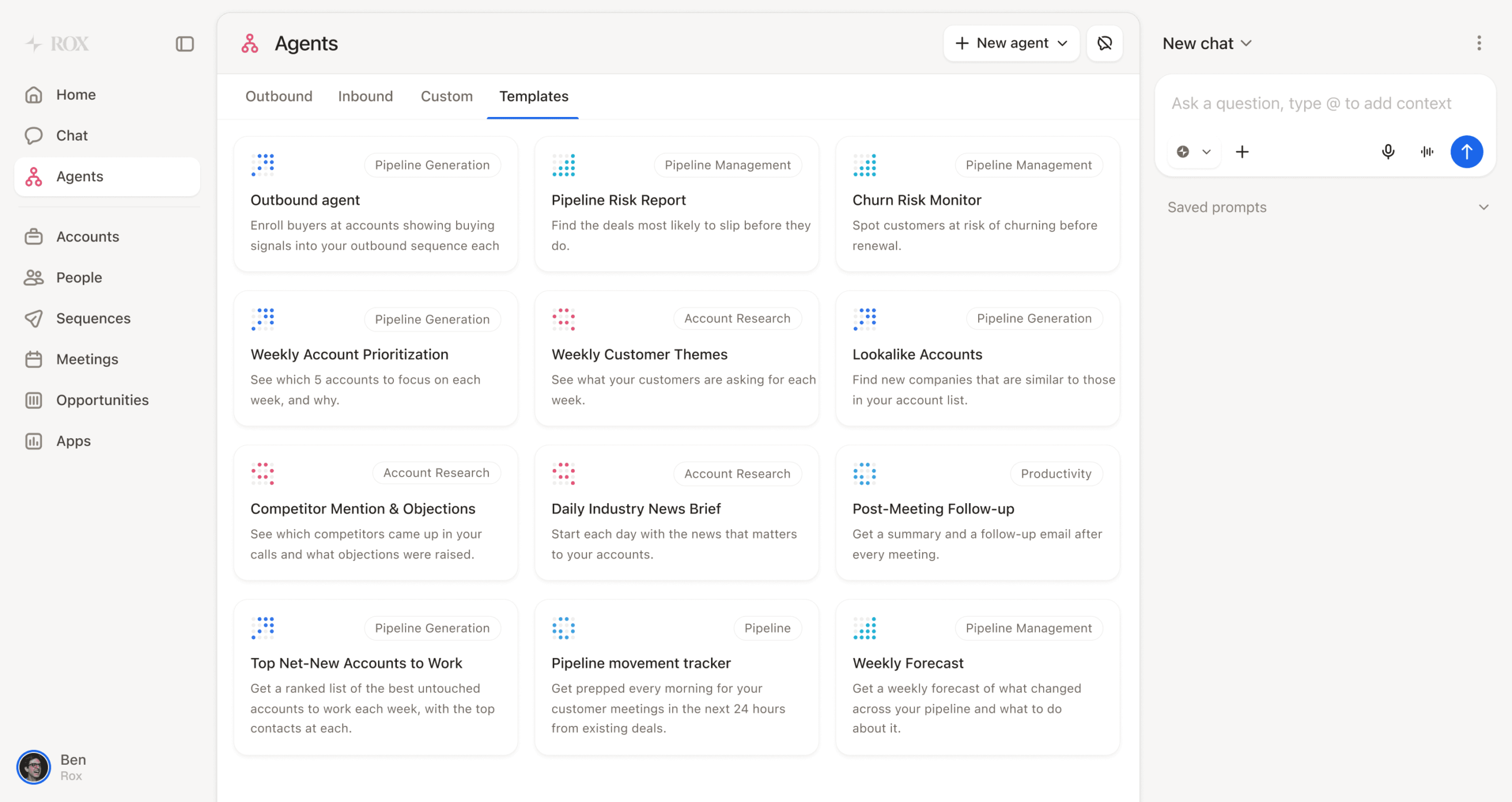
Rox has raised $100 million to change how some of the world’s largest companies handle sales and growth work. Announced on November 11, the Series B values the AI revenue-work startup at $1.3 billion. General Catalyst and March Capital co-led the round, with Sequoia Capital, Factory, GV, Databricks Ventures and Prosperity7 Ventures participating.
That is a substantial vote of confidence. But the more interesting part is where Rox is aiming: at a business workflow long shaped by established sales software, including Salesforce. Rox’s bet is not simply that companies need another tool with AI features. It is that AI agents make it possible to rethink how revenue work gets done from the ground up.

The pitch is bigger than a smarter CRM
Customer relationship management software has traditionally helped teams organize information about accounts, contacts and deals. That information matters, but someone still has to do the work around it: research prospects, spot changes in an account, prepare outreach, keep deals moving and look for opportunities to expand existing customer relationships.
Rox is building AI agents to take on some of those tasks. Its product is designed to work across pipeline generation, deal execution and account growth, using enterprise data and fitting into existing business systems. The ambition is to help sales teams spend less time coordinating routine work and more time making decisions and building customer relationships.
That distinction is important. Adding an AI assistant to an existing product can make a familiar task faster. Reworking the task around an agent asks a more fundamental question: if software can research, prioritize and prepare work, what should the human seller spend their time doing?
Rox is pursuing that question with large enterprises, the Global 2000 companies whose sales processes can be complex, data-heavy and costly to change. It is also a difficult place to earn trust. These businesses already have established systems, security requirements and habits built over years. A challenger cannot win on a clever demonstration alone. It has to show useful results while fitting into the realities of how large organizations operate.
Why take on an incumbent?
Competing with an entrenched platform is a familiar startup ambition. It is also a hard one to make credible. Incumbents have customer relationships, years of accumulated data, broad product portfolios and the advantage of being already embedded in daily work.
The opportunity appears when the economics of a particular job become difficult to defend. If companies are paying for software and still relying on people to perform hours of repetitive research and administration, a new approach can promise more than a nicer interface. It can promise to change how much effort the work requires and what the team can accomplish.
That is the opening Rox is pursuing. The company says its agents can help research accounts, find and qualify opportunities, prepare outreach, manage deals and identify expansion possibilities. Instead of treating every sales action as another feature for a person to click, it is building toward a system that can carry parts of the workflow forward.
Importantly, that does not necessarily mean a company has to rip out its existing CRM on day one. Rox can work with systems enterprises already use. For a startup challenging a deeply rooted platform, that can be a more practical route: enter through a valuable job, demonstrate measurable impact, and give customers a reason to expand adoption over time.

Early traction is a signal, not a guarantee
Rox reported that its annual recurring revenue grew more than tenfold in its first year in market. The company also said it is seeing more than 700% net revenue retention across enterprise customers, with some customers reporting around 25 times return on investment within 90 days.
Those are company-reported figures, not a promise that every deployment will produce the same outcome. They do, however, point to the kind of evidence customers and investors want to see: not just interest in AI, but an attempt to connect the product to pipeline, time saved and business growth.
That outcome focus is central to Rox’s story. When a product sells into a large company, enthusiasm is rarely enough to secure lasting adoption. Buyers need to understand what changes after implementation. Does the sales team find opportunities it would have missed? Does it spend less time on preparation? Can it reach prospects that were previously too costly to pursue? Can a team show its leadership that the investment is working?
For founders watching this raise, there is a useful distinction here: impressive financing validates investor conviction, while customer results have to validate the product. The work of turning one into the other continues long after the announcement.
Three lessons for founders taking on a giant
Rox’s strategy offers practical ideas for entrepreneurs building in markets dominated by familiar brands.
1. Start where the incumbent’s economics are hardest to defend
Do not begin with the broad claim that an established competitor is old or outdated. Look for a specific, expensive part of the workflow where customers are still relying on too much manual effort.
That might be research that takes hours, a process that limits how many customers a small team can reach, or a recurring task that consumes time without requiring a human to make every decision. The strongest entry point is often narrow enough to prove value, but important enough that customers care.
Ask yourself: Which job is frustrating, frequent and costly? What does it cost the customer to keep doing it the old way? Can your product show a meaningful improvement without requiring a complete system replacement?
2. Sell outcomes, not seats or features
A feature can be copied. A list of capabilities can sound impressive and still leave a buyer wondering what they are actually paying for. A clear outcome is easier to understand and measure.
Instead of leading with how many agents, dashboards or integrations a product includes, connect the offer to a result that matters to the customer. That might be more qualified opportunities, fewer hours spent on preparation, faster follow-up or better coverage of existing accounts.
Be disciplined about the proof. Choose a baseline, define what success looks like and agree on how you will measure it. That makes the sales conversation more concrete and gives the customer a reason to keep using the product after the initial excitement fades.
3. Design for how the work should be done
A common temptation is to copy the incumbent’s workflow, then sprinkle AI on top. That can be a sensible first step, but it may also preserve the very friction a new product is meant to remove.
Ask what the job would look like if you were designing it today. Which actions should happen automatically? Where does a person need judgment or approval? What information needs to be surfaced, and when? What should be easy to review, correct or hand back to a human?
The goal is not to remove people from valuable work. It is to give them more room to do the parts that depend on context, trust and good decisions. For Rox, that means trying to move sales teams away from administrative busywork and toward higher-value customer conversations.

The real challenge starts after the raise
A $1.3 billion valuation makes Rox’s ambition hard to miss, but the longer test is whether it can keep delivering value across different industries, data environments and sales teams. Enterprise customers need reliability, security and clear oversight, alongside the promise of automation. And revenue work is not a simple checklist: a signal that matters at one company may mean something different at another.
That is why Rox’s approach is worth watching beyond the funding headline. It is trying to use a new technology to rethink an established workflow, while still acknowledging that large companies have systems they cannot casually abandon. The strategy is ambitious, but the underlying lesson is useful to founders at any stage: challenge the incumbent by showing customers a better way to get an important job done.
The future of business software may not belong to products that simply add an AI button to yesterday’s process. It may belong to teams willing to rethink the process itself, prove the difference in practical terms and earn customer trust one workflow at a time. Watch how this one develops, because the playbook it is writing could outlast the funding headline.