


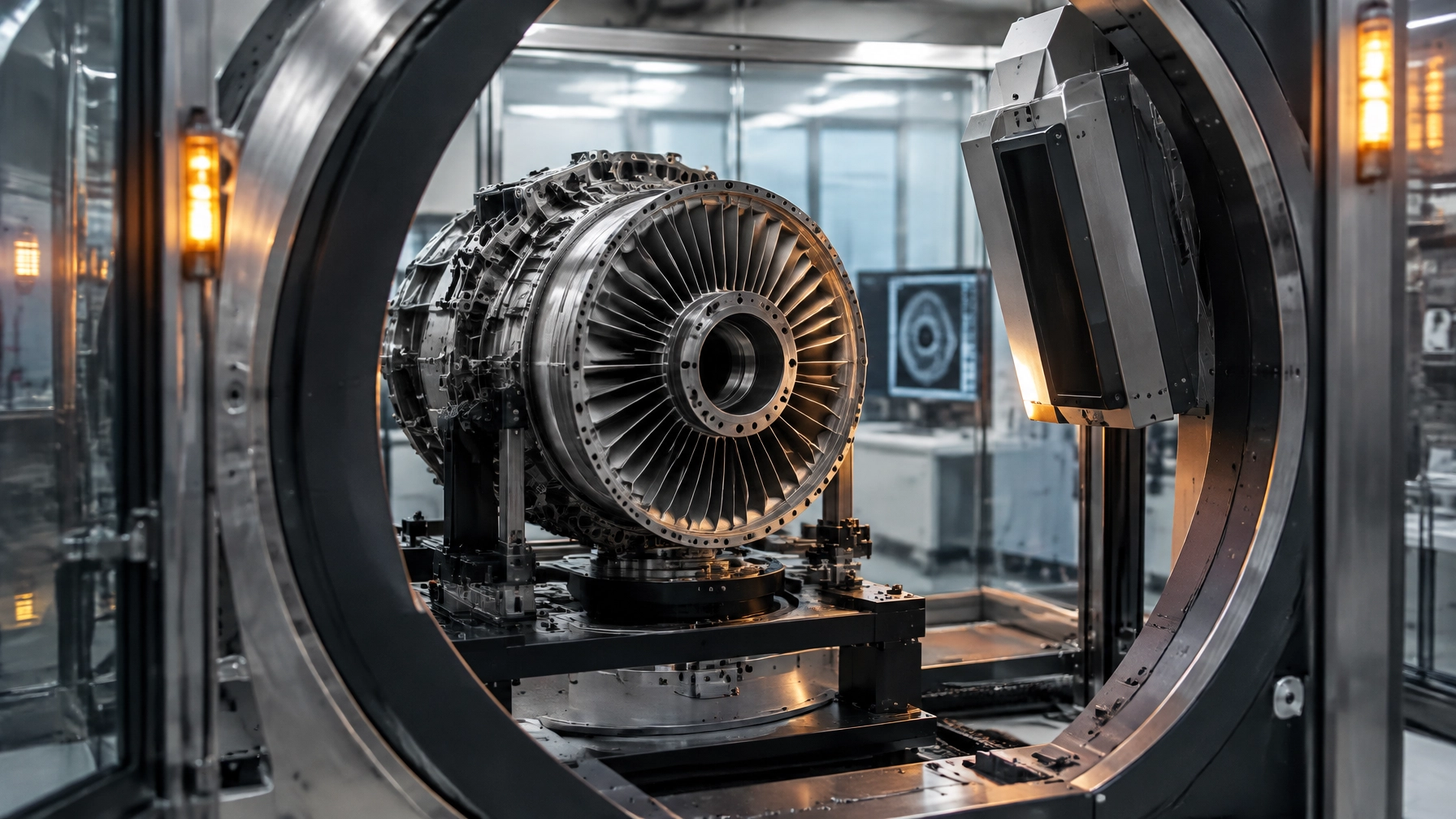
Some of the most important work in business happens before a product ever reaches a customer. A jet engine, medical device or electronic component may look ready to ship. But someone still needs to know what’s happening inside it.
That quiet work is at the center of a major deal completed today, November 2. Swedish industrial technology company Hexagon has closed its acquisition of Waygate Technologies from Baker Hughes for approximately 1.45 billion dollars in an all-cash, debt-free transaction.
The acquisition was first announced on April 13. Waygate will now operate within Hexagon’s Manufacturing Intelligence division, bringing its inspection technologies together with Hexagon’s metrology and software offerings. The combination is designed to connect more stages of inspection and quality management across a product’s lifecycle.
For business owners and founders, the deal offers a useful reminder: the capabilities customers depend on before they can buy, build or deliver anything can be more strategically valuable than they appear.
What Waygate actually does
Waygate specializes in non-destructive testing, or NDT. The basic idea is straightforward: inspect a product or piece of equipment for hidden defects without damaging it.
That can involve industrial radiography and computed tomography, remote visual inspection, ultrasonic testing and imaging solutions. These technologies help manufacturers and operators look inside components, assess their condition and find potential problems while keeping the inspected item intact.

This is not a flashy part of the product story. Customers don’t usually buy an aircraft engine because they’re excited about the inspection process behind it. But confidence in that engine, and in the systems that depend on it, relies in part on knowing whether critical components meet the required standards.
The same logic applies across industries. Medical devices have to be checked. Electronics need to work reliably. Industrial equipment must be assessed before it is put into service and, in many cases, throughout its working life. Inspection may not be the finished product, but it helps make the finished product dependable.
Waygate brings meaningful scale to that work. The business has approximately 1,500 employees across 25 global locations and generated roughly 630 million dollars in revenue in fiscal year 2025.
Why the acquisition makes sense for Hexagon
Waygate’s inspection hardware and expertise complement Hexagon’s existing metrology and software portfolio. Put simply, the companies are bringing together tools that can measure and inspect products with software and systems that help manufacturers understand and manage quality information.
The strategic opportunity is to make inspection less like a separate checkpoint and more like a connected part of production and product management. When measurement, inspection and data tools work together, businesses may be better positioned to identify issues, trace them and make decisions across the product lifecycle.

That matters because a defect discovered late can be more expensive to address than one caught earlier. It can mean rework, delays, scrapped materials or a product that cannot be delivered as planned. Inspection tools help companies see what they might otherwise miss, and connected data can help make that visibility useful beyond a single test.
For Hexagon, the deal also expands its presence in non-destructive testing. For Waygate, it places its specialist technologies within a broader portfolio focused on manufacturing intelligence. The acquisition is not simply about adding another product line; it is about combining capabilities that can support manufacturers at different points in the same process.
Waygate’s history also reflects how industrial capabilities can move and evolve over time. The business traces its roots to GE Inspection Technologies, built by General Electric roughly two decades ago before becoming part of Baker Hughes. Now it begins another chapter under Hexagon.
What the price suggests, and what it doesn’t
At approximately 1.45 billion dollars against roughly 630 million dollars in fiscal-year 2025 revenue, the purchase price works out to about 2.3 times annual revenue.
That simple comparison helps illustrate the scale of the transaction, but it is not a complete valuation analysis. Revenue is not profit, and a revenue multiple alone does not explain how a buyer evaluates a business. Strategic fit, technology, customer relationships, market position and the potential to combine operations and offerings can all matter.
Still, it’s worth noticing what kind of business Hexagon chose to buy. Waygate sells specialized inspection systems and capabilities that help customers verify the quality and condition of products and equipment. This is essential work, even when it is not the most visible work.
That distinction can matter for smaller businesses, too. A business does not have to sell something glamorous to become valuable. It can become indispensable by solving a recurring, costly problem that customers cannot afford to ignore.
The business lesson: build what customers need first
For founders, the takeaway isn’t that every company should build inspection equipment. It’s that there is strategic value in becoming part of the foundation customers rely on.
Ask yourself: what has to happen before a customer can confidently buy, use or recommend what I sell?
For a software company, the answer might be security, onboarding or reliable data migration. For a creative business, it might be rights management, consistent delivery or a trusted production process. For a small manufacturer, it could be dependable quality control. For a service provider, it may be the planning and follow-through that make the visible result possible.

The work that earns trust is not always the work that earns the most attention. But when customers depend on it, a quiet capability can become a strong source of differentiation.
A few practical questions can help uncover that opportunity:
- What problem keeps returning for your customers? Repeated requests, delays and workarounds can point to a need that is not being met well.
- What risk do customers want to reduce? Reliability, compliance, quality and delivery confidence can be valuable outcomes, even when they are hard to market with a catchy slogan.
- What must be true before customers feel ready to move forward? The answer may reveal a service, tool or process you can build into your offering.
- Can you make the process easier to trust? Clear standards, documentation, dependable support and consistent results can turn a basic capability into a reason customers stay.
This is not a call to chase every adjacent service or build complexity for its own sake. The strongest additions are closely connected to what customers already need and can be delivered well. The aim is to create usefulness that compounds: each customer relationship, improvement and proof of reliability makes the business more valuable to the people who depend on it.
The value of being quietly essential
Hexagon’s acquisition puts a spotlight on an industry most people don’t think about when they picture innovation. But the products we depend on are only as trustworthy as the systems that help verify them.
That is the deeper lesson in what Waygate sells. It sells ways to see what cannot be seen from the outside, and to help customers make decisions with greater confidence.
For business owners, that idea travels far beyond manufacturing. Look past the most visible part of your offer. The durable opportunity may sit in the essential work that helps customers feel safe enough to take the next step.
When a capability becomes something customers need before anything else can happen, “unglamorous” can be another word for foundational.