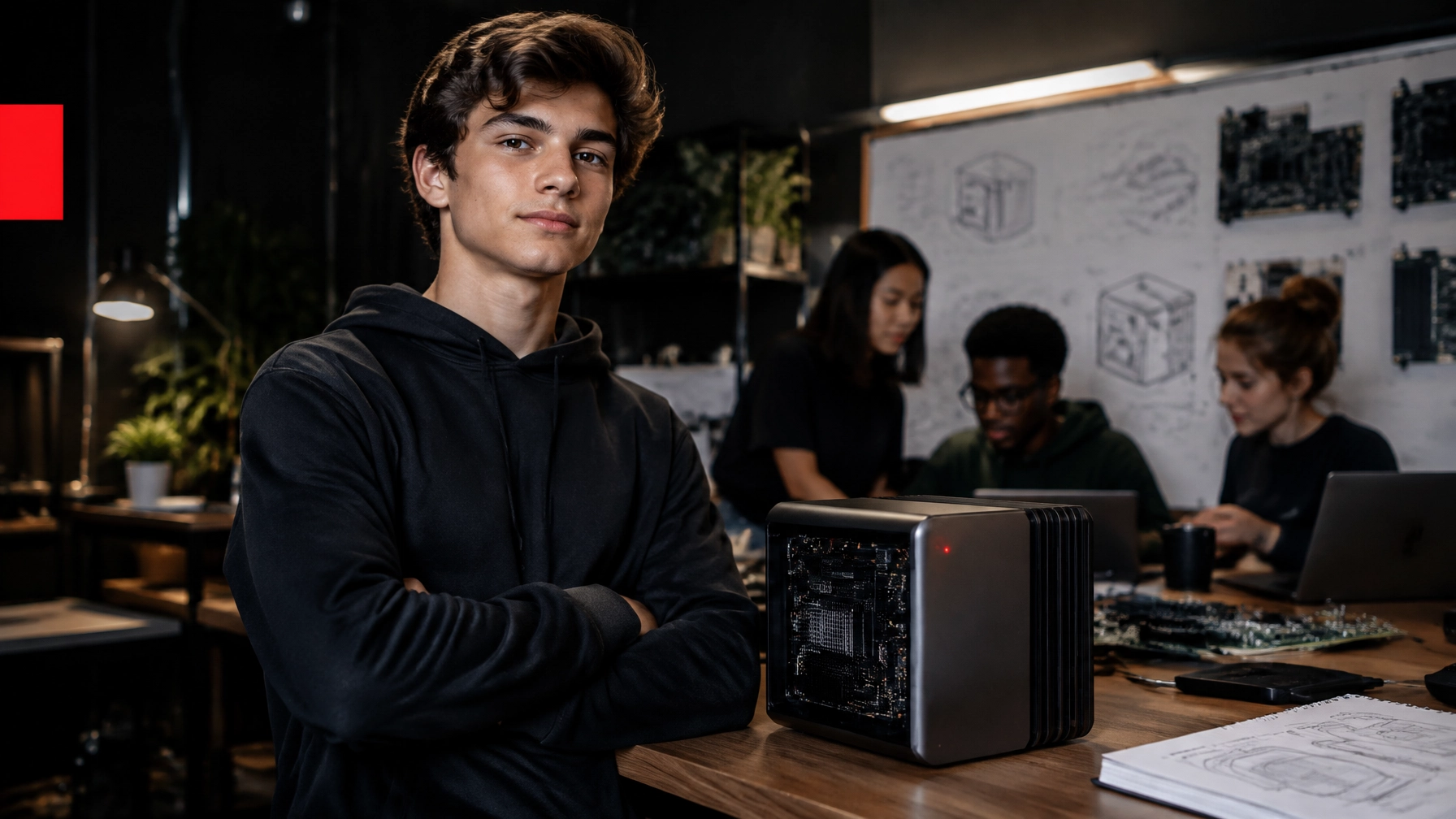
At 19, Zain Javaid has already done something many founders spend decades working toward: he has taken a high-conviction idea from stealth to an eight-figure funding round and a physical product launch.
Javaid and his Gen-Z team recently emerged from stealth with $11 million in funding for Ghost, the company behind Core. A $3,499 personal AI computer designed to run intelligent agents locally and continuously. The device is screenless, built around powerful hardware, and intended to function as a private “home” for a user’s digital context.
The story is remarkable because of Javaid’s age. But the bigger story is what it reveals about the 2026 startup landscape. Investors are not simply backing young founders because youth is fashionable. They are looking for people who can recognize a shift early, recruit the right team, move quickly, and make an ambitious idea feel inevitable.
For entrepreneurs of any age, the rise of teen founders offers useful lessons, and a few important warnings.
Core is more than an AI product. It is a bet on ownership
According to the official Core product page, the computer includes an NVIDIA RTX PRO 4000 Blackwell GPU, 64GB of DDR5 RAM, a 1TB NVMe SSD, and a six-core AMD Ryzen 5 7600 processor. It is built to run models and agents on-device rather than relying entirely on remote cloud infrastructure.
The product has no built-in screen. Users interact with it through connected devices while Core works in the background, processing information, managing tasks, and maintaining local memory. Ghost positions the machine as a dedicated home for personal intelligence rather than another traditional desktop computer.
That distinction matters. The product is not merely selling faster hardware. It is selling a different relationship with technology: more private, more persistent, and potentially more autonomous.
The first batch is listed as sold out, with shipments scheduled for October 31 and a second batch available for interest registration. Whether Core becomes a new category or an ambitious early experiment remains to be seen. But the launch itself shows how quickly AI is moving from software subscriptions into physical products people can own.

Why very young founders are attracting serious capital
A teenager raising $11 million for AI hardware would have seemed unusual not long ago. In 2026, it still stands out, but the conditions are increasingly favorable for founders who grew up fluent in software, online communities, creator culture, and rapidly changing AI tools.
1. They notice behavior before it becomes a market
Young founders often see emerging habits while they are still forming. They are close to the communities adopting new tools, experimenting with AI, and changing how they work, learn, create, and communicate.
That proximity can produce valuable insight. A founder does not need decades of industry experience to identify a meaningful shift. Sometimes the advantage comes from being close enough to the change that it feels normal rather than surprising.
Javaid’s path, from aspiring quant to AI hardware founder, reflects that kind of transition. The opportunity was not simply “build another AI app.” It was to ask what comes after cloud-based assistants and what a personal AI system might look like when it has dedicated computing power at home.
2. They are comfortable starting before the rules are clear
The youngest founders entering the market today have watched entire industries reorganize in real time. They have seen creators build careers without traditional gatekeepers, products launch through online communities, and small teams compete with much larger companies.
That experience can create a bias toward action.
Rather than waiting for a perfect business plan, young teams are often willing to test a rough idea, share progress, collect feedback, and adjust in public. In fast-moving categories like AI, speed of learning can be more valuable than the appearance of certainty.
3. They can recruit across borders and disciplines
A compelling founder story may attract attention, but a capable team attracts investment.
AI hardware requires more than a strong concept. It demands engineering, product design, supply-chain planning, software development, user research, security thinking, and operational discipline. No 19-year-old, or any founder, can master all of those areas alone.
The ability to recruit people with deeper expertise is therefore one of the most important signals in an early-stage company. A founder who can attract experienced builders, technical specialists, and practical operators demonstrates something investors understand: leadership is not about being the smartest person in every room. It is about creating a room where exceptional people can do their best work.
The lessons every entrepreneur can borrow
The story of Ghost is not a reason to compare your age with someone else’s. It is a reminder that credibility can be built earlier than many people think.
Build proof before you build a reputation
Young founders may not have long résumés, but they can create evidence.
That evidence could be a working prototype, a growing waitlist, a strong community, a series of customer interviews, a small but profitable service, or a public record of consistent shipping. Investors and customers respond to movement.
If you are starting today, ask yourself:
- What can I demonstrate instead of merely describing?
- Can someone use, test, buy, or share an early version?
- What measurable result would make the idea more credible?
Credibility is rarely granted in advance. It is accumulated through visible action.
Recruit people who are better than you
A founder’s ambition may open the door, but the team determines how far the company can go.
Recruit for the gaps in your ability. If you are visionary but disorganized, find an operator. If you understand customers but not the technology, find a technical leader. If you can build a product but struggle to communicate, bring in someone who can clarify the story.
The goal is not to assemble people who agree with you. It is to create a team that can challenge weak assumptions without slowing every decision.

Ship something tangible
Hardware is unforgiving because it turns promises into objects.
A software founder can update a product overnight. A hardware founder has to deal with materials, manufacturing, thermals, reliability, packaging, inventory, shipping, and returns. That complexity makes a physical launch risky, but it also makes progress easier to understand.
The same principle applies outside hardware. Entrepreneurs should look for ways to turn an abstract idea into something people can experience.
A consultant can publish a practical framework. An artist can release a small project instead of waiting for a perfect album. A creator can test a paid product with a limited audience. A business owner can launch one focused service before building a full platform.
Shipping creates feedback. Feedback creates clarity.
Tell a story that connects technology to a human need
Core’s technical specifications are impressive, but specifications alone do not create desire. The stronger message is about privacy, continuity, control, and having a personal AI system that belongs to the user.
Every entrepreneur should be able to answer a simple question: Why does this matter in someone’s actual life?
The answer should be clear enough for a customer to repeat. If people cannot explain the value of your product to someone else, the positioning probably needs more work.
The risks of raising too much, too young
The excitement around young founders can create pressure that is difficult to manage.
An $11 million seed round is an extraordinary vote of confidence, but it is not the same as product-market fit. Funding creates runway, not certainty. It also creates expectations from investors, employees, customers, and the public.
For a young founder, the risks may be especially intense:
- Overspending before demand is proven
- Hiring too quickly and losing team cohesion
- Confusing media attention with customer traction
- Giving away too much ownership too early
- Neglecting education, health, and personal development
- Building a product that is technically exciting but commercially narrow
The answer is not to avoid ambitious funding. It is to treat capital as a responsibility rather than a reward.
Founders should know exactly what each round is meant to accomplish. Is the money funding a prototype, a manufacturing run, customer acquisition, or a larger technical team? Clear milestones protect a company from turning momentum into waste.
Young entrepreneurs should also build a circle of experienced advisors who can offer perspective without taking control. A founder may have exceptional instincts and still need help with contracts, finance, hiring, manufacturing, and emotional resilience.
The real message for entrepreneurs in 2026
Zain Javaid’s story is inspiring because it challenges the traditional timeline of entrepreneurship. You do not need to wait until you have a perfect résumé, a prestigious title, or decades of experience before attempting something meaningful.
But the deeper lesson is not that every founder should raise millions before turning 20.
It is that opportunity increasingly rewards people who combine curiosity with execution. The winners will be the entrepreneurs who identify a real shift, build a clear point of view, recruit beyond their own limitations, and create something people can experience for themselves.
Age can be an advantage when it brings fresh perspective. Experience can be an advantage when it brings judgment. The strongest founders learn to value both.
For anyone building a company, creative project, or personal brand, the next step is simple: make the idea more real this week than it was last week.
Build the prototype. Interview the customer. Publish the first version. Invite someone more talented into the room. Then keep learning in public.
That is how credibility begins, long before the funding announcement.