


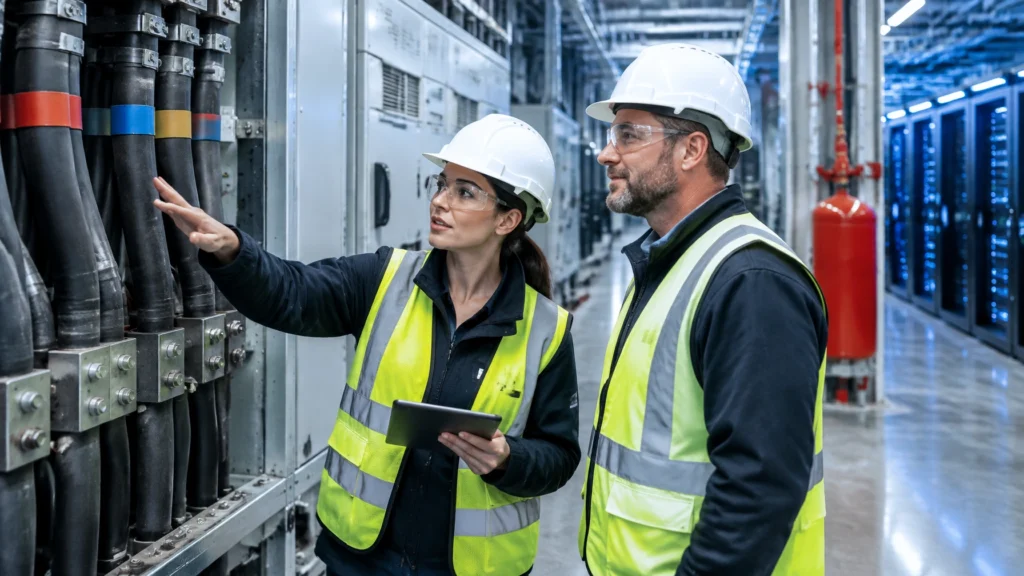
The artificial intelligence boom has a power problem. Not just a question of how to generate more electricity, but how to move it through buildings and campuses fast enough to keep up with increasingly demanding computers.
That challenge is now attracting serious investment. VEIR, a Massachusetts company developing superconducting power delivery systems for AI data centers, has closed an oversubscribed $110 million Series C, bringing its total funding to $225 million. Matter Venture Partners and Tyche Partners co-led the round, joined by new and existing investors.
The funding follows a successful demonstration of a system that delivered more than three megawatts through a single superconducting cable in a simulated data-center environment. VEIR says it is moving from demonstrating its technology toward commercial-scale manufacturing, with initial deployments targeted for 2027.
For most business owners, superconducting cables aren’t an immediate purchasing decision. The bigger signal is that electricity is becoming a strategic constraint on growth, not a background utility bill. And that shift could shape where businesses expand, what they pay to operate, and how quickly they can bring new facilities online.
The AI constraint is moving beyond the chip
AI systems need specialized chips, but those chips need enormous amounts of dependable power. The electricity must travel from the grid, through a facility, and to equipment that may be concentrated in a relatively small area.
That creates a physical infrastructure challenge. Conventional cabling and power equipment take up space, require materials and installation work, and have practical limits on how much power they can deliver over a given distance. When a data center needs more capacity, the solution may involve more than adding servers: it can mean rethinking power distribution, cooling, construction schedules, and even the site itself.
VEIR’s approach uses superconducting cables cooled with liquid nitrogen. The company says its cables can carry up to 10 times the power density in the same footprint as conventional options, while using substantially less copper. The system is also designed to reduce resistive losses and simplify installation.
Those are company-reported performance claims, and the technology still has to prove itself in commercial deployments. The 3-megawatt demonstration is an important milestone, but a simulated environment is not the same as a broad, operating data-center rollout. Scaling manufacturing, validating long-term performance, and delivering projects reliably are the next tests.
Still, the investment shows how urgently the industry is looking for new ways to move more power through constrained spaces. The bottleneck is no longer only what businesses can compute. It is also what their buildings and energy infrastructure can support.


Why a data-center story matters to businesses of every size
The connection to a neighborhood retailer, growing manufacturer, creative studio, or startup may not be obvious. Most businesses won’t need megawatts of power or superconducting cables. But energy constraints travel through the economy.
When electricity demand rises, businesses can feel the effects in operating costs, utility connection timelines, and competition for suitable commercial space. An expansion plan that once began with “How much room do we need?” may increasingly have to include “Can this location support the power we’ll need, and when?”
For a business with energy-intensive equipment, refrigeration, charging, manufacturing, or extensive computing, those questions are already practical. For other companies, the risk may appear more gradually: a new facility takes longer to energize, an upgrade costs more than expected, or a power bill becomes a larger and less predictable share of monthly expenses.
The lesson isn’t to panic or assume every business faces an impending power shortage. It’s to stop treating energy as invisible. Like rent, payroll, and inventory, energy can influence the margin between a promising expansion and a financially stressful one.
Energy belongs in the growth plan, not just the monthly bill
The companies best positioned for the next few years may not be the ones that simply use the least electricity. They may be the ones that understand their energy needs early and make informed choices about where and how to grow.
That starts with visibility. If you can’t explain how much energy different parts of your operation consume, it’s hard to spot waste, estimate the impact of adding equipment, or compare locations accurately. A basic energy review can reveal which costs are stable, which fluctuate, and which operational changes have the greatest effect.
It also changes site selection. A property can look perfect on paper (good access, room to expand, attractive lease terms) and still be a poor fit if its electrical capacity is limited or upgrades would take too long. For a power-dependent business, utility capacity and timing deserve the same early attention as zoning, loading access, and internet availability.
And energy planning is not reserved for large corporations. A growing company can start with a handful of practical questions and build from there.

Five practical moves to make now
1. Put energy on the regular financial dashboard. Track electricity costs alongside other major operating expenses. If possible, compare usage as well as total bills, so you can tell whether costs changed because of higher activity, higher rates, or a change in how equipment is being used.
2. Map your energy needs before you expand. List the equipment and systems that draw the most power. Then estimate what you’ll add over the next year or two. A simple forecast is more useful than discovering after signing a lease that a new production line, server room, or refrigeration system needs capacity the site can’t readily provide.
3. Ask infrastructure questions before committing to a location. Find out what power is available, whether upgrades may be needed, who pays for them, and how long the work might take. Don’t assume that a visible connection or a previous tenant’s setup will automatically meet your future needs.
4. Identify low-regret efficiency improvements. Maintenance, controls, scheduling, and equipment upgrades can help some businesses reduce avoidable consumption. The right measures depend on the operation, so prioritize improvements you can measure rather than treating every new technology as a guaranteed saving.
5. Build energy risk into your growth scenarios. When comparing expansion options, include a scenario where power costs rise or infrastructure upgrades take longer than expected. That doesn’t mean abandoning an ambitious plan. It means giving the plan a better chance of surviving contact with real-world costs and timelines.

A promising technology, and a bigger business lesson
VEIR’s $110 million round isn’t proof that superconducting power delivery will solve every data-center challenge. Commercial adoption will depend on performance in real projects, manufacturing scale, installation requirements, reliability, and the full cost of operating the cooling system. For potential customers, the right question won’t be only how much power a cable can carry. It will be whether the complete system makes operational and financial sense.
But the broader message is already useful: the infrastructure that enables growth is changing. As AI, electrification, and digital services increase demand, access to power, and the ability to manage it, can influence how quickly businesses can build and expand.
For entrepreneurs and operators, that’s an invitation to think ahead. You don’t need to be building a data center to treat energy as strategy. Know what your operation needs, understand what your next stage of growth will demand, and bring power capacity into decisions before it becomes an expensive surprise.
The next advantage may come not just from having a bold idea, but from making sure your business has the energy infrastructure to carry it forward.