


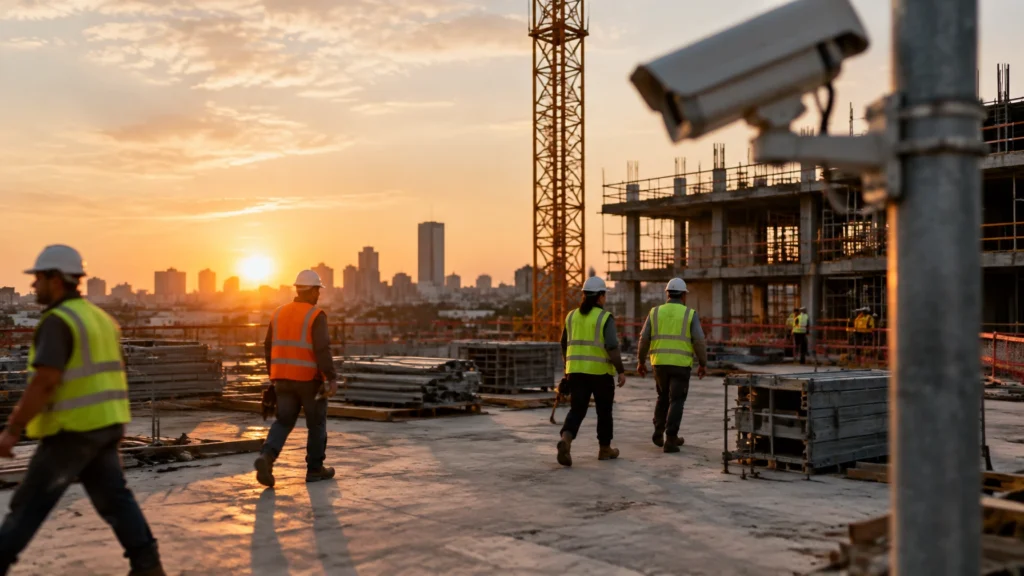
Most companies raising millions on AI want you to picture brand-new technology: a shiny device, an entirely new system, a dramatic change to the way a business operates.
Singapore-based Ailytics is taking a different route. Its pitch starts with something many industrial businesses already have: CCTV cameras. The company’s software, Ailyssa, turns those existing video feeds into real-time alerts about safety risks and activity on site.
On October 26, 2026, Ailytics announced a US$7.4 million Series A led by Tin Men Capital. The funding is set to support expansion across APAC, the United States and the Gulf, as well as growth in industries including manufacturing, logistics, oil and gas, maritime and mining.
The round is a timely reminder for founders: some of the strongest business opportunities aren’t about persuading customers to buy another piece of equipment. They’re about helping customers get more value from what they already own.
The cameras are already there. The insight isn’t.
On a busy construction site or factory floor, cameras can capture hours of activity. But footage often becomes useful only after an incident, when someone reviews it to work out what happened.
Ailyssa is designed to change that. It analyzes existing CCTV video and translates the two-dimensional footage into three-dimensional spatial understanding: where people and vehicles are, how close they are to one another, and whether an activity may present a risk.
That can mean flagging a missing hard hat, someone entering a restricted area or a worker moving dangerously close to heavy machinery. Instead of relying solely on a person to spot a problem in a live feed, or search through recordings afterward, the system can send an alert while there’s still an opportunity to respond.


The key idea is not that cameras are new, or that businesses have suddenly decided safety matters. It’s that the cameras already installed may be able to do more than record.
That distinction matters in industries where adding new hardware can mean extra cost, installation, approvals and disruption. Building around existing infrastructure can make the first step easier: a business can explore a useful new capability without starting from scratch.
A safety problem with a clear business case
Workplace safety is an urgent human issue. It is also a practical operating concern for companies managing complex sites, heavy machinery and large teams. A missed hazard can affect workers, schedules and costs. Better visibility can help managers spot patterns and take action sooner.
That gives Ailytics a straightforward way to explain why its software matters. It’s not selling “AI” as an abstract feature. It’s selling a chance to identify specific risks (such as unsafe proximity, PPE non-compliance or unauthorized access) using infrastructure the customer already has.
According to Ailytics’ announcement, the platform has recorded more than 5.7 million hazards and monitored over 500 million square metres of active worksites. The company also says customers have reported reductions in total recordable incident rates and safety non-compliances. Those figures aren’t a promise that every site will see the same results. They do show how the company is framing its product: around measurable outcomes, not impressive-sounding technology alone.
Ailytics says its software has been built for the conditions that industrial sites actually present, including poor lighting, dust, rain and obstructed views. That’s a demanding environment for computer vision, and a useful reminder that an AI tool has to work where the customer works, not only in a clean demo.
Four hundred deployments before the next leap
Founded in 2021 by CEO Lenard Tan and CTO Prateek Manocha, Ailytics has grown to more than 400 deployments across 15 countries. The company previously raised a US$2.7 million pre-Series A in 2024, also led by Tin Men Capital.
That deployment count is more than a headline number. Industrial customers don’t all have the same camera systems, layouts, workflows or safety rules. Building across many real-world settings gives a company the chance to learn what breaks, what needs to be adapted and which use cases can be repeated.
For founders, the lesson isn’t simply “get hundreds of customers before fundraising.” It’s to use each deployment as a chance to prove that the product can solve the same kind of problem reliably in a different setting. That learning can make the next customer easier to serve, and the business more convincing to investors.

The company’s expansion plans also follow a natural path from its early work in construction to adjacent heavy industries. Manufacturing, logistics, oil and gas, maritime and mining share some important characteristics: complex operations, substantial safety requirements and existing camera infrastructure. A solution proven in one demanding environment may have room to travel, but the details still need to fit each industry.
That’s a more grounded kind of scaling than simply announcing a new market. It starts with a capability that solves a repeated problem, then expands into places where that problem is familiar.
The founder lessons hiding in the funding round
Ailytics’ story offers a few practical ideas for entrepreneurs building in less glamorous corners of the economy.
1. Look for value hiding in existing assets
Businesses accumulate tools, data and infrastructure that may be underused. Before proposing a costly replacement, ask what could be unlocked by making those assets more useful.
That could mean helping a retailer make better use of inventory data, helping a manufacturer learn from machine logs, or helping an office put existing energy systems to work more intelligently. The opportunity may already be sitting on the customer’s balance sheet.
2. Lead with the outcome, not the machinery
“Vision AI that builds spatial understanding from video” may describe how the product works. But the customer is more likely to care about catching a hazard sooner, reducing manual review or improving oversight across a site.
Technical depth matters. It earns trust when it supports a benefit that a buyer can recognize, explain and measure.
3. Take the industries other founders overlook seriously
Construction, shipping, manufacturing and mining may not have the same shine as consumer apps. They do, however, face real and costly problems, and many have substantial room for better tools.
Working in these sectors requires patience. Customers may have complicated operations, compliance needs and established ways of working. But founders who learn those realities can build products that are much harder to replace with a generic, one-size-fits-all solution.

4. Expand through problems your customers already have
Ailytics’ move from construction toward other heavy industries makes sense because many of those customers share concerns around safety, visibility and operations. The lesson for a founder is to look for the next market near the one you already understand.
Existing customers can reveal where your product might travel next. Their workflows, suppliers and industry peers can point toward expansion paths that are more credible than choosing a new market simply because it looks large.
Making what’s already there work harder
Ailytics’ US$7.4 million raise reflects investor confidence in a specific idea: industrial businesses can get more from their existing cameras, and better visibility can help teams act on risks sooner.
The bigger takeaway for founders is refreshingly practical. Look closely at what customers already own. Find the problem that asset could help solve. Then prove the value in the places where the need is clear, even if those places aren’t the loudest ones in the market.
Sometimes the next big opportunity isn’t a new camera. It’s a smarter way to use the one that’s been watching the work all along.